
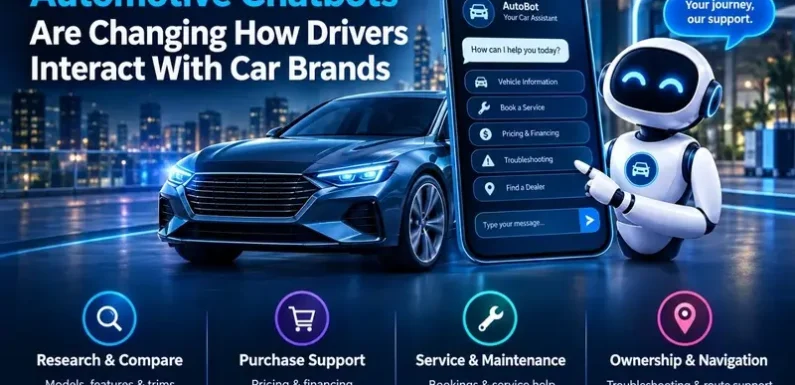
The automotive journey of customers is today typically digital in nature. Drivers increasingly use numerous forms of digital channels for research into vehicle models, comparison of their specifics, appointment scheduling, and getting information about car service. As such car-related digital interactions increase, automotive brands have started adopting chatbots to ensure quick and easy access to information.
Modern-day chatbots have the power to answer inquiries regarding the features of vehicles, scheduling of services, pricing details, and even providing basic troubleshooting advice. The appearance of AI technology has improved the capabilities of chatbots making them more conversational, context-aware, and user-friendly.
From Websites to Always-On Conversations
Automotive chatbots are tools implemented to deliver information using online channels. Whereas previous systems used static menus, modern systems with artificial intelligence can understand context. Apart from providing information about vehicles, chatbots can provide information on various aspects of vehicles.
As studies show, 45% of users have some difficulties in finding an appropriate vehicle-related information while 42% appreciate easy-to-use websites.
A Market Moving Beyond Basic Queries
As per the report of Dataintelo, the size of global automotive chatbot market stood at USD 312.4 million in 2024 with strong growth prospects ahead, with a CAGR of 24.1% from 2025 to 2033.
The growth is due to a transition to higher levels from simple website search to conversational assistance. A chatbot is capable of explaining specifications and assisting users with the digital processes. The importance of the chatbot is the fact that the answers can be obtained even after work.
Helping Drivers Before and After Purchase
The car chatbot serves to assist in the operation of the vehicle by the car owner. Car owners can inquire with the helpers about anything regarding service intervals, warning indicators, warranty periods, booking, and operating instructions. They can also communicate via chatbots with service centers.
Recent statistics show that 70% of drivers would choose to have AI assistance in real-time and 63% of people would like to receive assistance to adjust routes based on their needs.
Chatbots in the Automotive Journey
| Stage | Typical Chatbot Role | Numeric Context |
| Research | Explain models, trims, and features | 53% considered 3+ brands |
| Purchase | Answer pricing and financing questions | 48% wanted online credit applications |
| Service | Support appointments and maintenance queries | 24% cited long service wait times |
| Ownership | Provide operating and troubleshooting guidance | 70% would use AI for real-time diagnosis |
| Navigation | Support route and preference questions | 63% wanted personalized routing help |
These tools can support several stages without replacing human assistance.
Personalization Is Becoming More Important
Modern chatbots increasingly depend on context. Systems can potentially use information such as vehicle model, trim, service history, location, or previous questions, subject to privacy controls and customer consent. Context can make responses more relevant because guidance for one configuration may not apply to another.
Almost 75% of people has shared their disappointment with services that come bundled, similarly as many people has said that their online experiences do not match with their experience in real life. The integration should help companies, but for personalization a lot of accurate data is needed.
Generative AI Expands the Conversation
Generative AI is changing what automotive chatbots can handle. Instead of matching questions to a small library of predefined answers, newer systems can summarize technical information, explain vehicle functions, and handle follow-up questions.
Research involving 2,300 vehicle buyers found that 25% had engaged AI tools during shopping, while 59% of those users reported high satisfaction with AI-powered assistance. The figures show growing AI use.
Limits Still Matter
Automotive chatbots cannot safely replace every human or technical interaction. A response about a dashboard warning, brake problem, battery issue, or safety system can have consequences if information is incomplete or incorrect. High-risk situations require escalation to qualified technicians or official vehicle documentation.
Several factors determine whether a chatbot response is suitable:
- Accuracy matters because incorrect vehicle information can affect maintenance or safety decisions.
- Escalation is necessary when a question involves complex mechanical or safety issues.
- Privacy is important when systems process vehicle details, service records, locations, or account information.
- Context helps prevent generic advice from being applied to the wrong vehicle configuration.
- Translucency allows drivers to understand whether they are directed using automation.
The 2025 review of 84 research papers shows that usefulness, trustworthiness, ease of operation, and perceived risk are some of the influential aspects of chatbot adoption. One must ensure not only high-quality communication if they want to be successful.
The Road Ahead
Automotive chatbots have joined a bigger digital system that connects websites, applications, service platforms, and cars. Recent studies show that 87% of respondents came across online tools while buying their cars and 25% of car buyers thought about buying a vehicle online.
Conversational AI is another type of interface that helps people find out about cars and automotive services. The cars of the future will have to provide accurate data about the cars, inform users about the limits of their usage, enhance the privacy of their users, and allow the possibility of receiving human assistance for complicated situations.
FAQs
- What is meant by automotive chatbots?
Automotive chatbots are software programs that use artificial intelligence in order to inform vehicle users about anything related to vehicles.
- What are the benefits of automotive chatbots in helping the drivers?
They provide quick answers to questions about vehicle performance, service schedule, troubleshooting, cost, and navigation while issues that are more complex can be passed to the human agents for assistance.
- Do automotive chatbots have capabilities for servicing cars?
Yes. Automotive chatbots can provide essential information about maintenance, schedule appointments, and inform users about basic requirements for service.
- In which way does AI enhance car chatbots?
AI allows chatbots to interpret language questions, keep track of conversations, summarize details and give responses that are better than standard rules-based systems.
- What are the disadvantages of car chatbots?
Chatbots may not be effective in dealing with complicated mechanical, safety, or diagnostic problems. Such cases might need the help of qualified professionals or the official car documents.
Author Bio –
Ashish Kolte is a Marketing Manager at Dataintelo with expertise in marketing, market intelligence,
and business strategy. He combines marketing insights with industry research to analyze market
trends, identify growth opportunities, and provide data-driven perspectives on emerging industries
and global business developments. LinkedIn: https://www.linkedin.com/in/ashishkolte/
