
The global reach of financial technology applications keeps increasing. The companies establish digital wallets together with payment platforms and lending services and mobile banking applications. The organizations partner with established fintech development service providers to create secure financial platforms which comply with regulatory and security standards.
FinTech application development requires structured organization to achieve successful results. Financial systems need to handle delicate user information while complying with established security protocols. The development team needs to establish connections with payment gateways and banking APIs and fraud detection systems. The total development expenses depend on these mandatory project specifications.
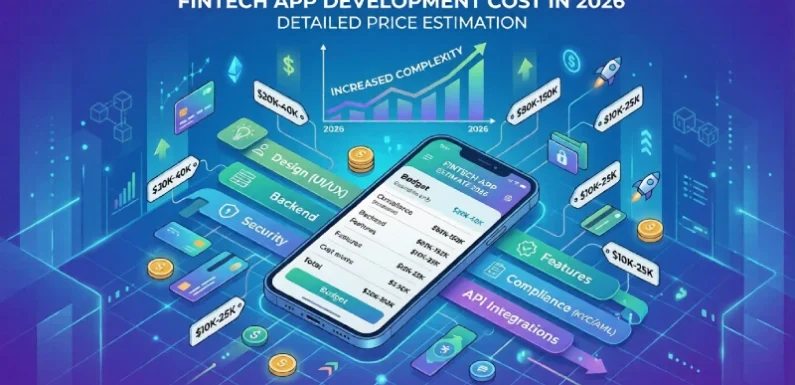
Average FinTech App Development Cost in 2026
The costs of FinTech applications depend on two factors which are the platform complexity and the necessary features required by the application. The standard development budget includes three different types of FinTech needs which are:
- Basic FinTech MVP: $40,000 – $80,000
- Mid-level FinTech application: $80,000 – $150,000
- Advanced FinTech platform: $150,000 – $350,000+
The basic MVP requires user accounts and payment processing and transaction tracking functionality. The version enables startups to test their product concept before they spend money on developing a complete platform. The advanced platforms provide users with digital wallets and investment dashboards and AI-based financial analytics and fraud monitoring systems. The added functionalities create higher engineering demands which need more infrastructure resources to operate.
The development budget requires evaluation of both the development team location and the associated regional costs. North American development teams tend to charge their clients at higher hourly rates than Eastern European and Asian development teams. Many startups therefore build distributed teams to balance quality and development costs.
Key Factors That Influence FinTech App Development Cost
Feature Complexity
The development budget depends on the particular feature set requirements of the project.
Basic financial apps often include:
- User registration and authentication
- Payment processing
- Transaction history
- Push notifications
More advanced platforms may include:
- Fraud detection systems
- AI-based financial insights
- Multi-currency payment processing
- Open banking integrations
Each new feature necessitates the development of backend systems and API links and further testing procedures. The development time required for the platform increases as it progresses through different stages of growth.
Security and Compliance Requirements
Security holds high importance for financial software applications. Developers use encryption protocols together with secure authentication systems and monitoring tools to safeguard financial data.
FinTech applications need to follow multiple regulations which include the following requirements PCI DSS payment security standards and GDPR data protection rules and KYC identity verification and AML transaction monitoring. The standards make development processes more challenging yet they establish secure methods for processing financial transactions while safeguarding user data.
Third-Party Integrations
FinTech platforms require external services for their operations.
The system integrates with these common services:
- Payment gateways
- Banking APIs
- Identity verification systems
- Credit scoring services
The team needs to spend development time for each integration, and they must conduct testing, and they need to handle maintenance tasks. The level of integration difficulty depends on two factors, which are the documentation quality and the API restrictions that third-party providers put in place.
Platform Selection
The number of supported platforms also affects development costs. Companies often launch financial apps on several platforms which include iOS mobile applications and Android mobile applications and Web dashboards and Administrative panels.
Cross-platform technologies can reduce development time because they enable developers to create applications which run on multiple platforms without needing to develop separate native applications for each platform.
FinTech App Development Process
Building a FinTech product requires multiple stages.
Product Discovery
The discovery stage defines the product concept and architecture.
The teams evaluate business objectives together with user requirements and compliance standards. The stage establishes technical specifications while minimizing development risks before programmers start their work.
UI and UX Design
The designers develop financial interfaces which provide users with simple navigation.
Financial products must display complex data clearly. User experience improves through well-structured dashboards which also create user trust in digital financial services.
Application Development
Developers create both the backend system components and the applications that users will interact with.
The current phase of the project contains payment processing systems and API integration capabilities and transaction management systems and user account functionalities.
Testing and Security Validation
The testing process verifies that all financial transactions operate as intended.
Security testing assesses three components which include encryption protocols and authentication systems together with their ability to handle heavy transaction loads.
Launch and Maintenance
Development teams conduct performance monitoring after the launch process to identify and address potential system issues.
The system receives continuous updates which enhance its stability while delivering new features that users have requested.
Technologies Used in FinTech App Development
The choice of technology solutions determines how well systems can scale and how they perform under different conditions. The FinTech industry employs these technologies for its development work:
- Mobile applications use React or Flutter as their development frameworks
- js and Java serve as backend development frameworks
- AWS and Azure provide cloud infrastructure solutions
- PostgreSQL and MongoDB function as database systems
Financial platforms use cloud infrastructure to handle increasing user demand. The system runs continuously while providing users protection through various data safeguarding techniques. Modern FinTech systems use microservice architecture to divide their main functions into separate components for payments and authentication and analytics. The development team achieves better system performance through independent service updates which enhance system reliability and facilitate system growth.
Tips to Reduce FinTech App Development Cost
Development budgets can be managed in companies by several ways.
Start With an MVP
The minimum viable product enables startups to confirm their product concept through fast testing.
The business uses feedback to identify essential features which will be developed in upcoming software releases.
Use Cross-Platform Development
The development process becomes faster when developers use either the Flutter framework or the React Native framework.
Developers can build applications for multiple platforms using one shared codebase.
Work With Experienced Development Teams
Engineers, with their familiarity in this field, will reduce the risk of development and simultaneously avoid making architectural mistakes.
Professional teams also ensure compliance with financial regulations and security standards.
FAQs
How much does FinTech app development cost in 2026?
The fees for FinTech applications are usually nonspecified and can be anything from 40k to 350k, subject to complexity and integrations.
How long does it take to build a FinTech app?
Development usually takes between four and twelve months.
What features are essential for a FinTech app?
Essential features include user accounts, payment processing, transaction tracking, and notifications.
Why do FinTech apps require strong security?
Financial applications need to handle sensitive information together with their financial processing tasks. The system security measures stop fraudulent activities while safeguarding user data.
Can startups build FinTech apps with limited budgets?
Yes, many startups are well known for launching MVP products initially before gradually incorporating new features once they have gained some traction.
Conclusion
FinTech application development requires careful planning, strong security systems, and scalable infrastructure. The total development budget needs to consider these three factors. The cost of a basic MVP starts at approximately $40,000.
Financial platforms that require complex analytics and system integrations and compliance systems will have costs exceeding $300,000. Security architecture and regulatory compliance and scalability should become the main focus for companies who plan to build financial platforms.
Proper planning and experienced development teams help businesses launch reliable FinTech products faster while reducing long-term development risks.
Author Bio
Yuliya Melnik is a technology writer specializing in software development and financial technology. She writes about digital payments, FinTech platforms, and modern product engineering approaches used by custom fintech software development services providers to build secure and scalable financial solutions.
